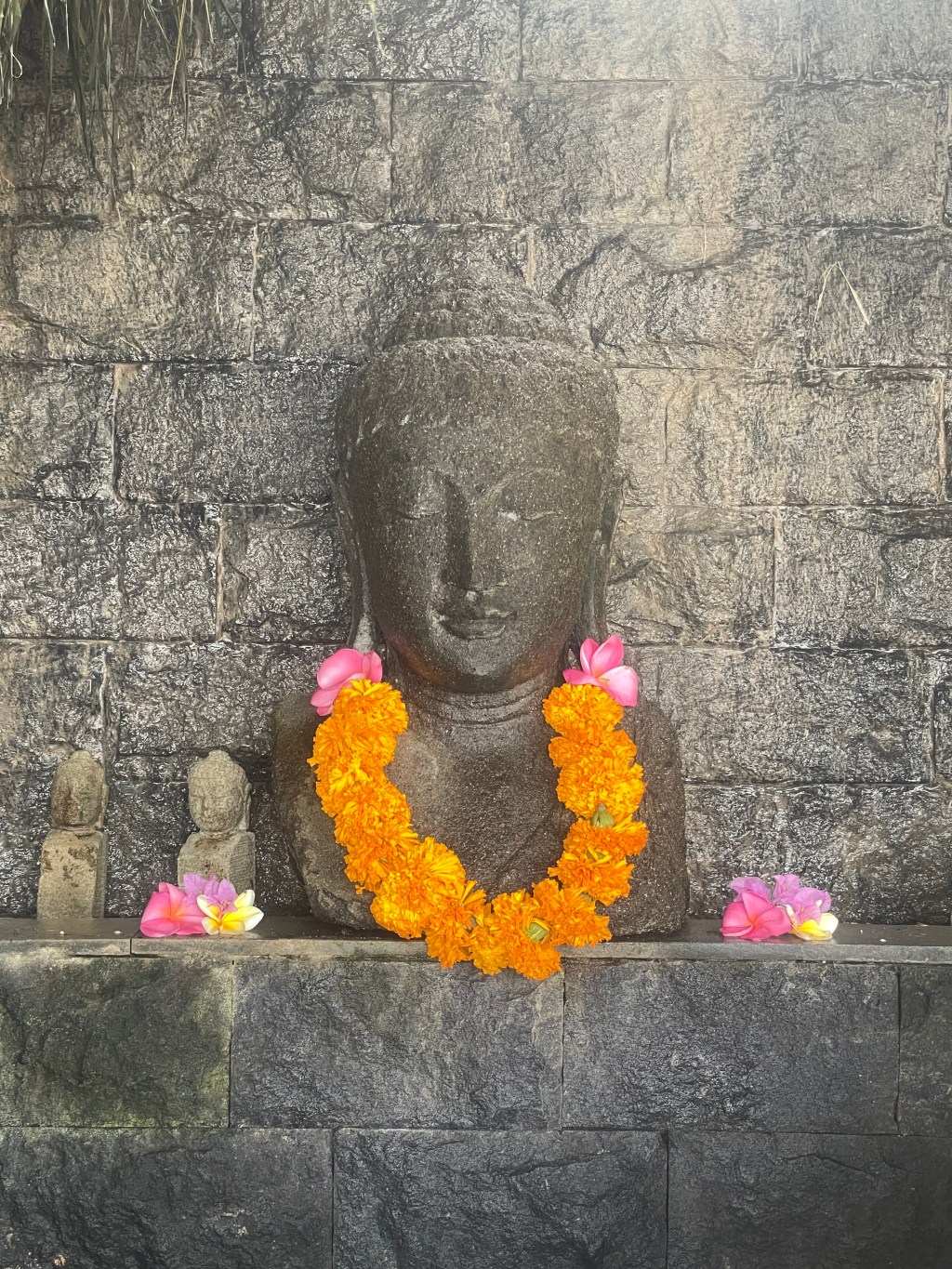
We are on a small island off the coast of Bali. Remote times two. It’s nice and warm here. The sea and pool both a balmy 27 degrees. The sun warm enough to make Sydney’s cold winter grip feel like nothing but a distant memory. If we leave the poolside, it’s to watch the sunset with a cocktail in hand, swimmers still on. And to eat, of course. The fish is divine – fresh out the ocean. And we’ve devoured a bellyful of Nasi Goreng and Chicken Satay (sate, on the menu).

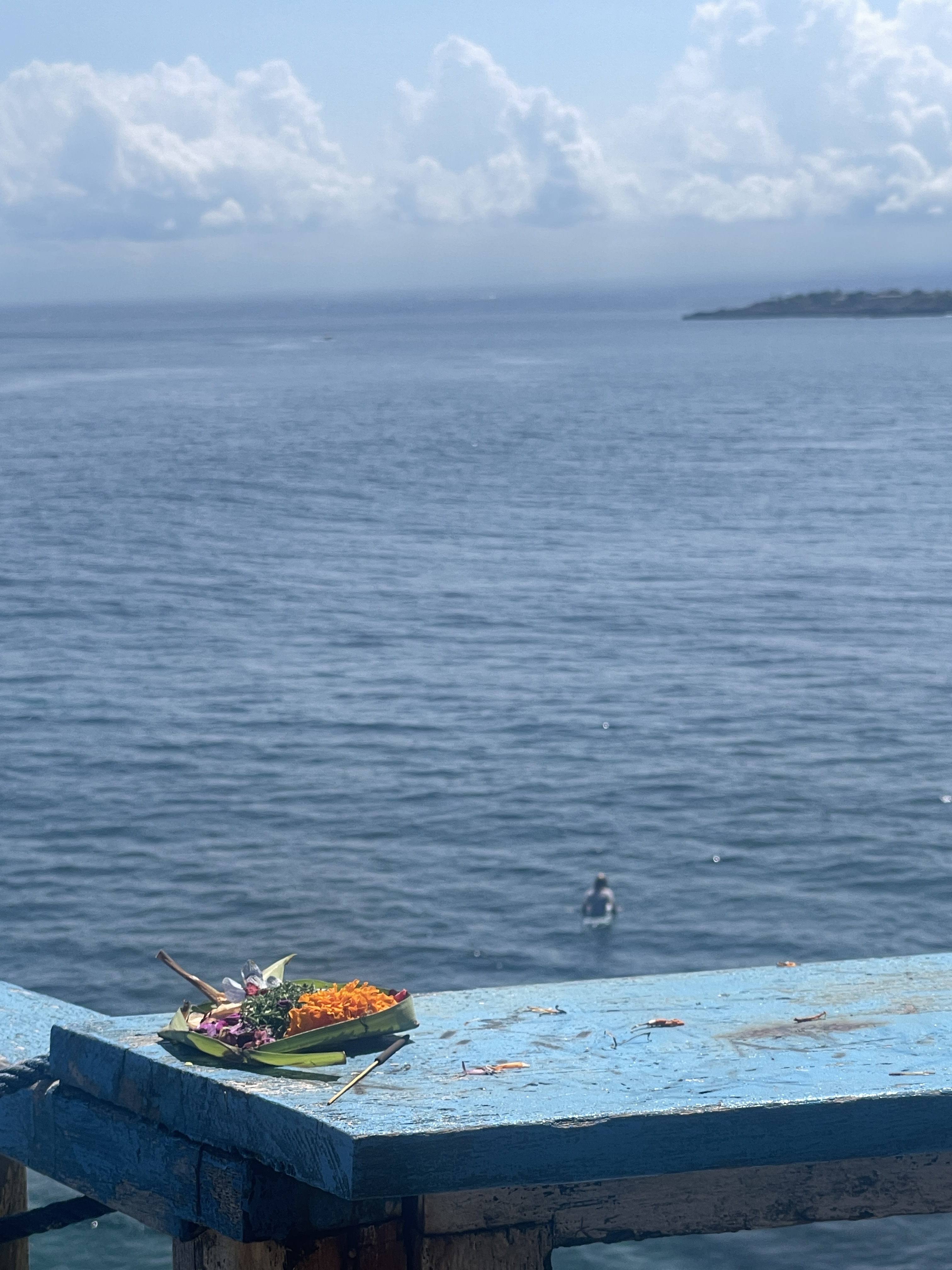
Breath in. The air smells of ocean and incense. Everywhere lie the remnants of offerings – a basket weaved out of banana leaf, and some brightly coloured flowers, nuts, or trinkets. In a few cases a cigarette, or a stick of incense long burned out. They are placed in the mouths of the shrines that crowd every inch of the island. On road corners, and every entrance to villas or restaurants or beaches or shops. Granite black or grey blocks, square and sharp, stacked on top of each other to support a little alter, covered with stone and in some cases an umbrella. They’re all subtly different, it seems. Some are reminiscent of houses, others bring to mind a lion’s mouth.


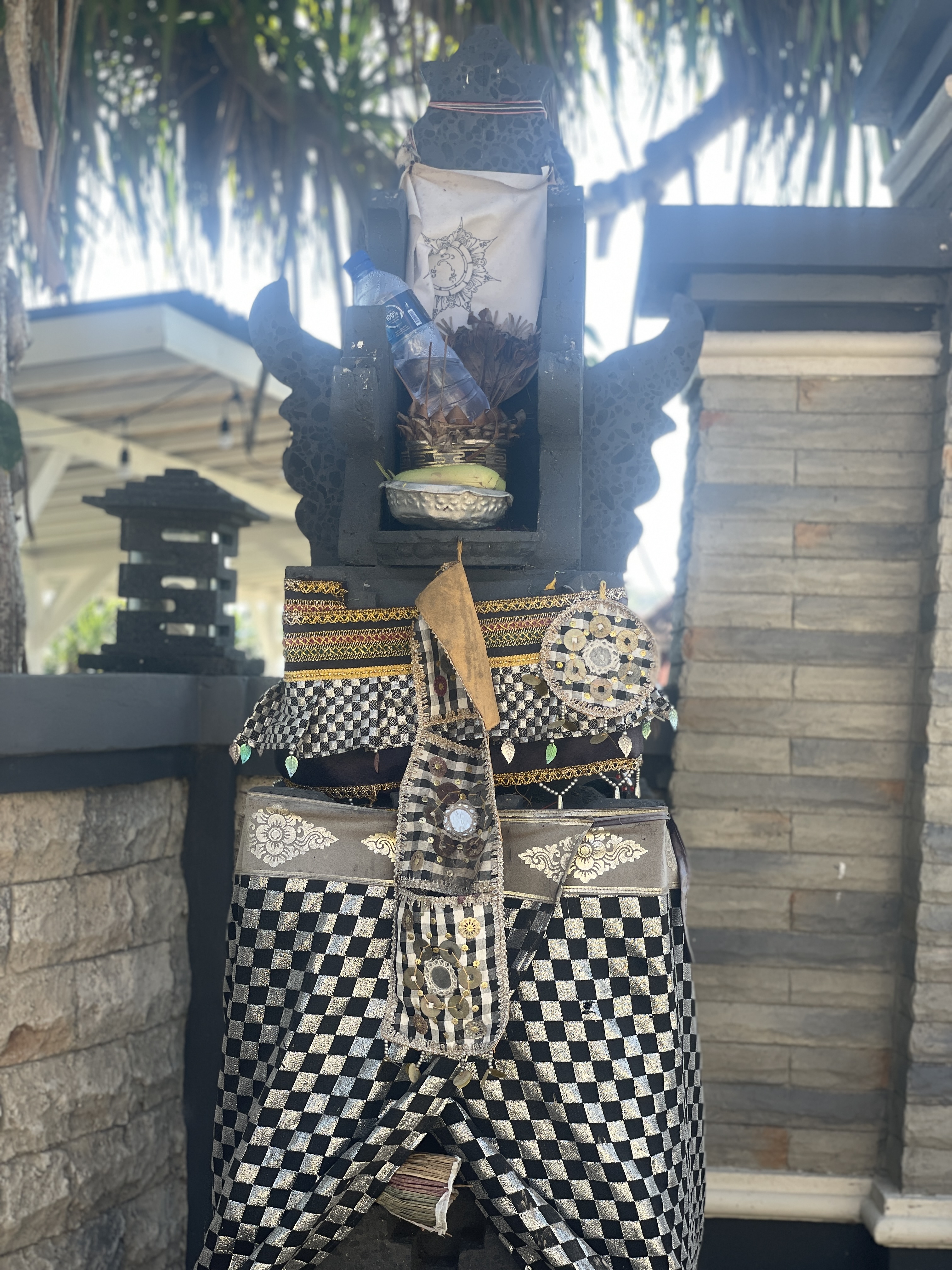
These delicate offerings, carefully prepared and laid out morning and night, sprinkled with holy water from the temples themselves, are also left in the laps of statues of what may be Gods or animals, but probably both. A dancing lion, a fierce looking bear, the hint of an elephant or eagle. Or they are left on the floor in front of doorways, or near anywhere the gods may be lurking, ready to receive an offering or ward off danger. Often statues and shrines both are adorned in a checked cloth cotton sari, sometimes protected by an umbrella fashioned out of the same material.
Today the owner of the place we are staying at does his rounds, cigarette in hand, re-laying offerings that his father-in-law had left not an hour before. The birds follow quickly in his wake, which seems delightful, and keeps the air twittering with the same sense of calm and happiness that seems, at least from outside, to pervade the culture and essence of the place we are visiting.
Last time I was here, the lady doing my nails told me about the white dots painted on her face and chest. It’s from their morning ceremony, she tells me, where they gather as a family to remember their ancestors. I don’t know if this was a regular thing, or an anniversary type thing, or even just a private spiritual practice, but the value of ancestors in Balinese culture is not to be underestimated. Ancestor worship, combined with animism, sit at the heart of many a ceremony, regardless of what traditional Hinduism or Buddhism might command.
The relevance of this is not lost on me today. For today my father has been my dead ancestor for 11 years. It seems fitting here to ponder on the notion of rituals, for this written ode to my father, that I do year in, and year out, is perhaps mine. This once a year deliberate remembering of my forebear. The man whose DNA makes up 50% of every cell in my body and lives on in the cells of my children too.
I don’t have much time for religion, which seems on current evidence to spiral quickly out of hand into blind rule-following, authoritarianism and the oppression of free thought, knowledge, and the rights of others, particularly women. But one thing they do well is ritual. And rituals have value, or at least they can. They ground us in time and give us something that connects us to the past and the future, and our tribes in general. They offer solace, and in their actions, space in which to reflect. Which is so often missing in the smash and grab of modern living.
And another positive. All religions, regardless of their colour or origins, hold that you should count your blessings. That an attitude of gratefulness is key to a sense of wellbeing in the world. And this, at least, has scientific backing. We are not naturally thankful creatures. Our minds are tuned to the negative. We notice danger and attend far more quickly and automatically to the downsides than the upsides of life.
This makes evolutionary sense. We are the ancestors ourselves of nervous apes, who in their propensity to see danger at every turn made it far enough down life’s perilous pathway to procreate and pass on those nervous genes to their children, our forebears. We have to train ourselves to see the good, which lies all around us. We have to practice gratitude, for it is not natural to us. But in doing so, we can teach our brains to generate a slightly more optimistic model of the world in which we live. A ritual of counting your blessings, of being thankful for all we have, lies at the heart of a sense of wellbeing.
Around me everywhere are blessings galore. I’m surrounded by a cobalt blue sea, warm weather, and spectacular sunsets at the moment. I’m spending time with my family and enjoying the luxury that comes with free time and money to spend in whatever manner I choose.

But for today, I think I want to count the blessings of being the child of an ever present, albeit deeply flawed father. He taught me that nothing was more important than family and being there for others, and he and my mom gave me four wonderful siblings to share the ride of life with. He was generous to a fault, and it is from him I inherited my sense of doing the right thing. He believed in me and saw immense potential in who I could be in the world, should I want to. He rescued me, protected me and taught me how to protect myself, and nothing, quite nothing, compares to the bear hugs he doled out frequently. When I was a little girl, nothing felt safer than being hugged by my father. My son, now taller and stronger than me, seems to have inherited this capacity for strong hugging, for which I’m also secretly delighted.
But more than anything, I’ve only realised very recently, he continues to show me, for this is a lesson I find hard to make stick, that we don’t need to be perfect to be loved or worthy of love. For he was not perfect by any stretch of the imagination, and yet I loved, and continue to love, him wholly and completely.
In memory of you Dad. Love always.
Onwards,
Sharlene, 27 June 2023


 Midlife Unpacked
Leave a comment