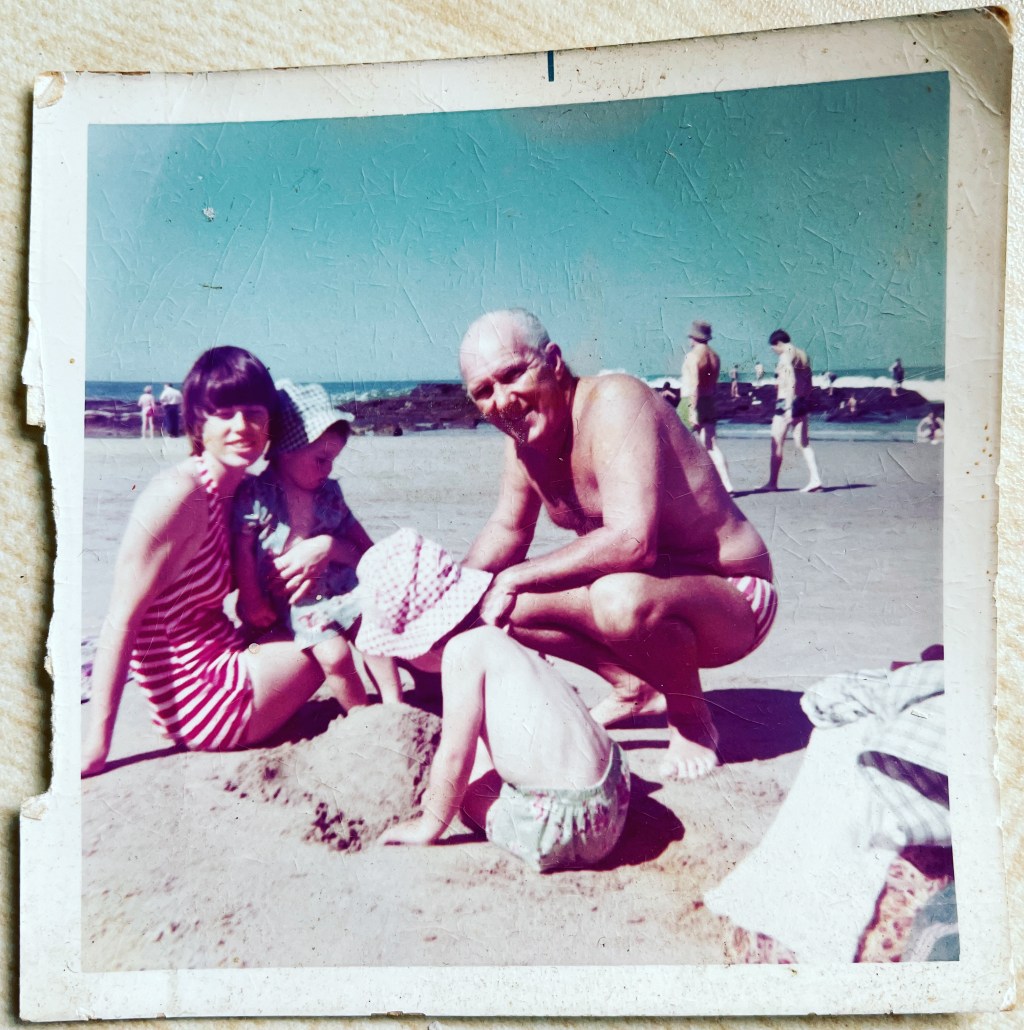
When I was a little girl, probably 4 or 5, just before big school I think, we lived in a house with a pool. I remember this pool because I have a memory of my uncle sitting in the bottom of it in scuba gear.
I have a lot of memories from this house.
Random memories like my father running outside in the middle of the night stark naked to throw water on fighting dogs; or being in bed, sick with fever and missing out on Christmas day. There was a horrible experience of body wide boils and a remembered sense of my sister hoarding her raisins and not sharing them with me, cos I ate mine too fast. I can recall the metallic smell of my parent’s stamping press thing, and the intricacies of my mother’s knitting machine, less firm timewise in my mind. My dad loved a machine. They’re speckled across my life.
But there are more foundational memories too. The origins of stories that went on to shape some of the way I am in the world. The way I respond to things. Such are the nature of our memories, which form the basis of our sense of self.
I remember my dad forcefully telling my sister to stop being shy when my uncle arrived at the front door one day. This same uncle who donned a wetsuit and descended to the pool floor. I recall her hiding behind my mother’s legs, and my sense that some things made my dad cross, and that shyness was bad. I’m pretty shy, but you’d never know it.
Or walking home from daycare, where red-headed Frederick had tried to kiss me by the sandpit, and I’d had to run into the Butterfly room to escape. And the teacher there telling me that this was the quiet room (and to get out). My first experience with boys (and a lack of consent).
Memories are strange things. Bubbles of brain matter, connected together in time and space through synapses – cells with long wavy arms and fat heads – that transmit information to and from each other through a process of electro-chemistry. A series of chain reactions, driven by the movement of potassium and calcium and neurotransmitters, that connect together in a network of associations – and when triggered, give rise to our thoughts, and our memories. Our conscious experiences.
Our brains are not video recorders. What is laid down in our neural real estate is not “everything”, but rather the bits that stood out to us at the time – captured in sensory traces (sounds, sights, smells) in different parts of the brain, and activated together by some associated cue.
Stand in a pharmacy, aged 18 and missing home, smelling Old Spice and suddenly everything you love about your father is brought to mind. A sensory hug from 2000 km away, as the chemicals released into the air by opening the bottle enter your nose and activate your brain and the associated experiences – the memories – with it.
Join my mailing list – subscribe here
Our memories are not static, set in stone. In each recollection, our memories are reformed and slightly altered, connected to new things in new ways. Although memories feel like replays of reality, they are not. Instead, in the process of remembering, our brains recreate the past.
Yet, we are, to quite a large extent, the sum of our memories – that is, our take on our experiences. What we notice, how we deal with them, how we interpret them. Our sense of self is a construct formed over time, built on the genes we are handed out by the copulation of our parents at a particular moment in history.
One of my most foundational memories – a core memory – from this time is what I call my “you’re not welcome” memory. I don’t know why this experience sits with me, or became so influential in how I viewed myself for so long. It wasn’t even a big thing, but to this day I can trace my fear that I might not be welcome or safe in a social situation, a fear I still battle with, to this childhood moment.
This memory relates to a childhood playmate. A neighbour, whose name I can’t even remember. How strange the things we do hold on to, and what we forget. I used to go over to her house to play a lot. There was even a hole in the fence between our houses through which we scurried. She was older. And one day, she had a friend there who said “Why are you always here. Every time I come here, you’re here?”
Did she say “you’re not welcome here” or was that just my interpretation? What happened afterwards? I don’t recall, although it is associated with the colour of shame. Why does this memory stick over all the wonderful friendships and encounters I’ve hand both before and since? Because your brain remembers when and where you feel unsafe. It’s a survival mechanism. And suddenly realising you are not welcome in a place you thought you were is as dangerous as it gets for social creatures like ourselves.
Perimenopause is a bastard, and it brought back from the past my oversensitivity to feeling unwanted. I did a lot of work to sort my inadequacy nonsense out, but my experience with perimenopause has been less about hot flushes and a lot more about a heightened emotional reactivity. Some people can’t control their temperature. My emotional regulation is all over the chip shop.
When you burst into uncontrollable tears in a restaurant because your hypersensitive hormone afflicted mind tells you your husband is rejecting you because he chooses to side with the menu choices of his mate, you got to think there is something deeply wrong with you. Embarrassing, much?
I’m a why person. I’m curious about the underlying causes of pretty much anything. So I deconstruct myself on a regular basis. And when I think about my “rejection sensitivity” (self-diagnosed, is it in the DSM-5?) I can unwind the string all the way back to the house with the pool.
Does it help to know this? That who we are and how we view the world are merely the buildings constructed on experiences of the past? I think so. We say we can’t change the past, but the past only exists in our memories. And those, we’ve established, are less video grabs of real events, and more a filtered, alterable version of the bits of the experience we focused on at the time. We might not be able change the past, but we can interact with those memories to reframe them in a more positive light.
What happens if I go back to that house with the pool, and through the bushes to the house next door and see the story from a different angle. To see these older girls on the verge of teenagehood – battled their own hormones and brimming over with tween-mind secrets. It is such a shit stage for girls. So full of change and fragile egos, misplaced anger and confusion. What if I didn’t fit in that day not because there was anything wrong with me, but just because I was too young for the moment?
Can I create new synapses this way? New memory traces that don’t lead to that “you’re not good enough, fun enough, smart enough” feeling that activates when I feel like I don’t quite fit in somewhere?
I think so.
Today I’m battling with the self-same feelings. I’ve indulged those feelings a little, but it is better not to. Better to choose to lay down the memory trace “this is not about you”, listen to some music, drink some wine and move on. You have to keep doing it of course. Lay down stronger traces which happens with time. Overwrite the old pathways. We can reframe our pasts to reset our future responses. We just have to practice.
And so, onwards.
 Midlife Unpacked
Leave a comment